
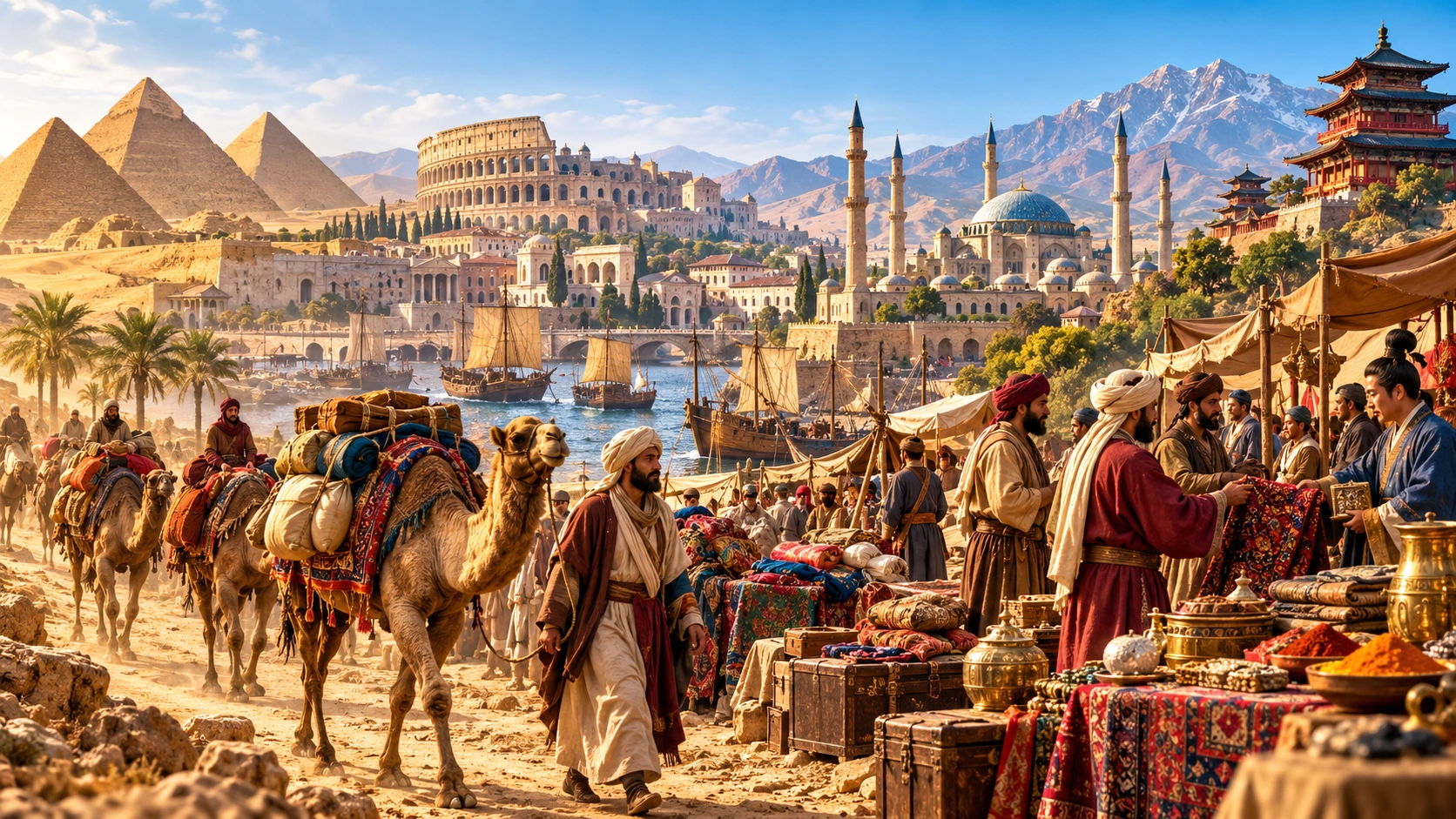
Ancient civilizations did not develop in isolation. Long before modern roads, railways, airports, and shipping networks existed, merchants, travelers, and explorers crossed deserts, mountains, rivers, and seas to exchange valuable goods. These ancient trade routes connected distant communities and played an important role in the growth of some of the world’s most influential civilizations.
Trade was about much more than buying and selling products. It encouraged cultural exchange, introduced new technologies, spread languages and ideas, and helped cities become centers of economic and political activity. From the Silk Roads across Asia to maritime routes across the Indian Ocean, ancient trade networks helped shape the development of human societies.
The Importance of Early Trade
Early communities often had access to different natural resources depending on where they lived. One region might have fertile farmland, while another had metals, gemstones, timber, salt, or valuable textiles. Trade allowed communities to exchange these resources and obtain products that were unavailable locally.
As trade became more organized, settlements located along important routes gained advantages. Merchants needed places to rest, store goods, obtain food, and conduct business. As a result, trading settlements could gradually grow into prosperous towns and cities.
Trade also encouraged people to specialize in particular occupations. Craftspeople could focus on producing pottery, metal objects, textiles, jewelry, or tools because they could exchange their products for food and other necessities.
The Silk Roads and Cultural Connections
The Silk Roads are among the best-known ancient trade networks. Rather than being a single road, they consisted of interconnected routes linking parts of China, Central Asia, the Middle East, and Europe.
Silk was one of the valuable commodities transported along these networks, but merchants carried many other products as well. Spices, precious stones, metals, textiles, ceramics, and other goods moved between distant regions.
The importance of these routes extended beyond merchandise. Travelers carried languages, artistic traditions, religious beliefs, scientific knowledge, and technologies between communities. Buddhist ideas, for example, spread into Central and East Asia through networks involving merchants, monks, and travelers.
Cities located along these routes benefited from the movement of people and goods. Central Asian trading centers became important meeting points where different cultures interacted.
Maritime Trade and the Indian Ocean
Sea-based trade was another major force behind the development of ancient civilizations. The Indian Ocean connected East Africa, the Arabian Peninsula, India, Southeast Asia, and other regions.
Merchants learned to use seasonal monsoon winds to plan their journeys. Ships could carry large quantities of goods, making maritime trade an efficient way to connect distant coastal communities.
Indian Ocean trade involved products such as spices, textiles, beads, metals, ceramics, and luxury goods. Ports became important economic centers where merchants from different backgrounds met.
The exchange was not limited to goods. Coastal communities were exposed to new languages, customs, religious traditions, technologies, and artistic influences. Over generations, these interactions contributed to culturally diverse societies in important port regions.
Trade and the Growth of Cities
Trade routes often encouraged urban development. A successful trading city could generate taxes and employment while attracting merchants, artisans, administrators, and travelers.
Markets became gathering places where goods from different regions were exchanged. Governments also recognized the economic value of trade and sometimes invested in roads, bridges, ports, storage facilities, and security.
As cities became wealthier, rulers could use trade revenues to support armies, public buildings, religious institutions, and administrative systems. In this way, commercial activity could contribute indirectly to political power.
Technology Traveled With Merchants
Ancient trade routes also helped spread practical knowledge. Merchants and travelers encountered different methods of agriculture, navigation, metalworking, textile production, and transportation.
Knowledge could be adapted by communities to suit local conditions. Navigation techniques, shipbuilding knowledge, writing systems, mathematical ideas, and manufacturing methods could travel across considerable distances.
The movement of technology demonstrates why trade routes were important even when particular goods were no longer being transported. An idea or technique introduced through trade could continue influencing societies for generations.
Trade, Diplomacy, and Political Relationships
Commercial relationships sometimes encouraged diplomatic connections. Rulers had economic reasons to maintain stable relationships with neighboring regions and important trading partners.
Trade agreements could help secure access to valuable resources. Diplomatic exchanges also allowed rulers to establish relationships, negotiate agreements, and manage disputes.
However, trade routes could also become sources of competition. States and cities sometimes sought control over strategically important routes, ports, and markets because these locations could provide substantial economic and political advantages.
The Long-Term Legacy of Ancient Trade
The influence of ancient trade routes can still be seen today. Many modern cities developed from settlements that once served as commercial centers. Cultural traditions, foods, languages, artistic styles, and religious practices often reflect centuries of interaction between different communities.
Ancient trade demonstrates that globalization is not entirely a modern phenomenon. People have been creating long-distance connections for thousands of years, although the speed and scale were very different from those of today.
Ultimately, ancient trade routes helped civilizations grow by connecting people and resources. They encouraged economic development, supported cities, spread knowledge, and created opportunities for cultural exchange. Their legacy reminds us that human progress has often depended on connections between societies rather than development in isolation.